Commercial dehumidifiers, 60–150 L/day
Portable units with digital control panels, for warehouses, factories, offices, retail spaces, basements and data centers.
Commercial and industrial dehumidifiers from Foshan, China — portable commercial units and vertical industrial units, for warehouses, factories, basements and garages.
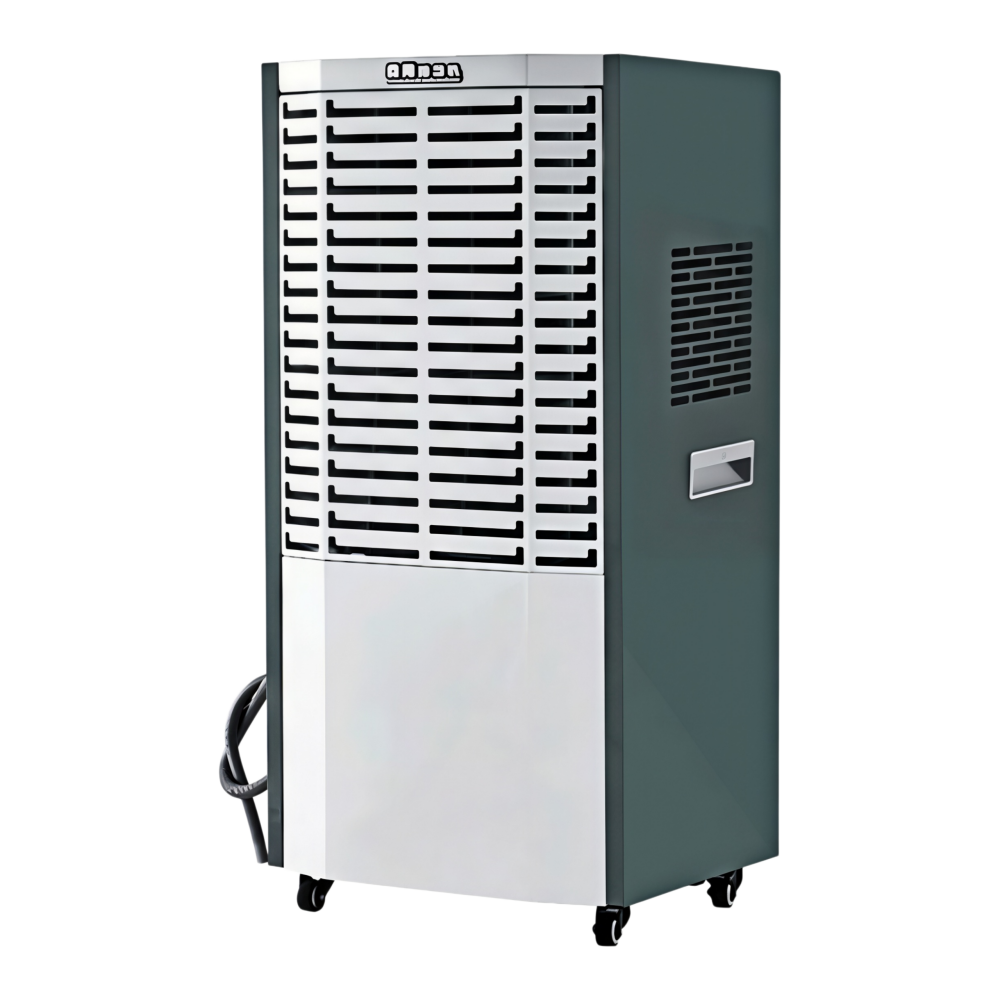
A dehumidifier has one job: take water out of the air, at a stated rate, in the space it serves. This site lists the two dehumidifier lines the manufacturer publishes — portable commercial units and vertical industrial units — with the specification tables from its own product pages, so buyers can compare models on verified figures instead of catalogue claims.
Digital control panel humidity ranges, as published on the product pages
Portable units with digital control panels, for warehouses, factories, offices, retail spaces, basements and data centers.
Vertical units with digital humidity regulation, for factories, storage facilities, workshops and large commercial spaces.
Portable commercial unit: 1.49 L/h parameter, 960 W rated power, 80–140 m² applicable area.
Larger portable commercial unit: 2.3 L/h parameter, 1250 W rated power, 130–170 m² applicable area.
Vertical industrial unit: 12 L/h, 4300 W rated power, 450–500 m² applicable area.
Heavy-duty vertical industrial unit: 20 L/h, 7600 W rated power, 600–800 m² applicable area.
Dehumidifier capacity is published in two languages, and this site keeps them apart. The commercial line names its models in litres per day: the page titles read 60–90 litres per day and 138 litres per day, and the comparison page spans 60 to 150 litres per day. The commercial parameter blocks, however, state capacity in litres per hour: 1.49 L/h for the DH-D-60BD and 2.3 L/h for the DH-D-138BD. The industrial line names its models in litres per hour — 12 L/h and 20 L/h — and its page graphics add daily ranges of 240 to 328 litres per day and 440 to 528 litres per day. A buyer comparing a commercial unit against an industrial unit is therefore comparing figures published in different units, and the comparison only works if each figure is kept in the place its own page gives it. This site never converts one into the other: the product pages state no test conditions for either figure, so no conversion between them is legitimate, and the blog on this site explains the point in full.
The practical consequence is simple. When a supplier quotes a commercial unit, ask which figure the quotation uses — the page-title daily figure or the parameter-block hourly figure — and get the answer in the same writing as the model number. When a supplier quotes an industrial unit, the hourly figure is the parameter-block value, and the daily range is the page graphic's claim; both are quoted here as stated, each labelled with where it comes from. A quotation that mixes the two languages without saying so is a quotation that cannot be checked, and a buyer who cannot check a quotation cannot compare it against another. The comparison table below keeps the two languages in separate columns for exactly that reason, and the guide page walks through sizing with the same separation.
The table below compares the four models that have full parameter blocks on the manufacturer's own detail pages. It is a summary for orientation only: the full tables, with every row, stand on the model pages, and any figure used for ordering must be taken from the full table of the model being ordered, not from this summary. Two cautions apply to the whole table. First, the capacity column keeps the two languages separate: the commercial models show the parameter-block hourly figure, and the industrial models show the hourly figure with the page-graphic daily range beside it. Second, the applicable-area column is the figure each detail page states for its model; areas are not interchangeable between models, and no area figure is stated for any model that has no detail page.
| Model | Capacity, as stated | Power (rated / maximum) | Power supply | Air volume | Applicable area |
|---|---|---|---|---|---|
| DH-D-60BD | 1.49 L/h (parameter); page title 60–90 L/day | 960 W / 1100 W | 220V~50Hz | 500 m³/h | 80–140 m² |
| DH-D-138BD | 2.3 L/h (parameter); page title 138 L/day | 1250 W / 1750 W | 220V~50Hz | 750 m³/h | 130–170 m² |
| DH-D-12IH | 12 L/h; page graphic 240~328 L/D | 4300 W / 4650 W | 380V 3N~50Hz | 3000 m³/h | 450–500 m² |
| DH-D-20IH | 20 L/h; page graphic 440~528 L/D | 7600 W / 8400 W | 380V 3N~50Hz | 6500 m³/h | 600–800 m² |
The commercial comparison page tables a fifth set of rows — the DH-D-60BD1, DH-D-90BD1, DH-D-138BD1 and DH-D-150BD1 models — but those rows come from a summary comparison table, not from detail pages, and they are presented only on the commercial family page, with the attribution that status requires. The DH-D-138BD1 row in that table is a different model from the DH-D-138BD detail-page model, and the two are never merged: the detail-page model reads 1250 W rated power and 130–170 m², while the table row reads 1200 W and 150–250 m². A buyer who treats them as one model will order on the wrong figures. The family page sets out the full comparison table with each row labelled by its source, so the distinction stays visible where the models are compared.
Each model page reproduces the parameter block from the manufacturer's own detail page for that model, with the same fields, the same figures, and the same order. Where a detail page states a feature as a company claim — the corrosion-resistant casing described as ensuring 8 or more years of use on the commercial pages and 10 or more years on the industrial pages, the 15 to 20 percent electricity-cost reduction described on the commercial pages, the panel ranges of 30 to 80 percent relative humidity on the commercial pages and 30 to 90 percent on the industrial pages — the claim is quoted as the page's claim, and the evidence bar on this page labels the company-profile facts the same way. Where a detail page is silent, this site is silent too: no parameter block states a tank volume in litres, a refrigerant type, a sound-level figure, or a net weight, and none is stated anywhere on this site. The contact form carries the standard note: confirm the items no page states before payment, including the commercial terms that no page publishes.
The commercial pages list warehouse storage, factory production areas, basements in commercial buildings, food processing plants and pharmaceutical storage warehouses, with textile mills and electronics factories named among the factory applications, and basements, factories, storage rooms and data centers named on the larger commercial page. The industrial pages list factories, storage facilities and workshops, warehouses, manufacturing plants and storage facilities, basement utility areas, food and beverage processing facilities and pharmaceutical manufacturing plants, with large-scale factory production lines in automotive, electronics and machinery plants named on the larger industrial page, and underground garages, shopping malls, bath centers and drying rooms named in the page graphics. The application pages on this site — warehouse, factory, basement and garage — take their application lists from those pages only, and say so where the list ends and buyer questions begin. No application page adds a building type the source pages do not name.
Collected water has to go somewhere, and the two lines answer that question differently. The DH-D-60BD detail page describes a removable water tank or a drainage outlet for continuous operation, and the summary comparison table marks only that model as having a tank. The DH-D-138BD page describes a high-capacity water tank with a drainage outlet, without a water-drawer feature row. The industrial pages describe integrated drainage systems for continuous disposal, with no tank mentioned at all. No page states a tank volume in litres for any model, so no tank volume is stated on this site. The practical question for a buyer is whether the installation allows a drain hose run — a floor drain, a sink, a pumped route — or whether collected water must be carried away in a tank that someone empties. The answer decides between a drainage installation and a tank installation, and the blog on this site sets out the two arrangements with the facts each page gives. A buyer with no drain point should say so in the inquiry, because it changes which models fit the installation.
Before ordering, confirm: the exact model and voltage for your site, the area and humidity load you need to cover, MOQ, lead time, and warranty. This page lists only what the source material verifies; anything not listed here is a question to ask, not a specification to assume.
Send your application, the area to be dried, and the voltage at the installation, and ask for a layout using the models on this page. Before payment, confirm MOQ, lead time, voltage, and warranty for your order.